
Case study · 08
StubHub Email Redesign & Modular Template System
As StubHub prepared to move its CRM email program to Salesforce Marketing Cloud (SFMC), I designed a new customer-facing on-sale email template with the CRM marketing team. The redesign applied product design principles to email, updated the visual hierarchy, and introduced adaptable content modules. The goal was to create a clearer mobile experience and give the team flexible layouts to test after the new platform was ready.

Executive Summary
As StubHub prepared to move its CRM email program to Salesforce Marketing Cloud (SFMC), I designed a new customer-facing on-sale email template with the CRM marketing team. The redesign applied product design principles to email, updated the visual hierarchy, and introduced adaptable content modules. The goal was to create a clearer mobile experience and give the team flexible layouts to test after the new platform was ready.
The Challenge
The earlier email relied on dense event listings and repeated full-width purple buttons. The team needed a more scannable presentation for event recommendations and a modular approach that could support different campaign content and future layout tests.
- Visual overload: Repeated, high-emphasis calls to action competed with event information.
- Limited flexibility: The existing layout made it harder to vary content modules across campaigns.
- Product consistency: Email styling needed to feel more aligned with StubHub’s product design standards.
Design Solution & Approach
1. Modernizing visual architecture and hierarchy
- Featured event: Led with artist imagery, then grouped event date, time, venue, and ticket action for quick scanning.
- Content discovery: Used multi-column recommendation cards, contextual labels such as “On sale today” and “20% off today,” and social-proof details to help distinguish events.
- Performer recommendations: Added image-led spotlights, including circular artist and event imagery, to break up text-heavy listings.
- Brand and trust: Refined typography, spacing, rounded imagery, and supporting colors around StubHub’s purple; gave FanProtect and customer-support content a clearer place in the email.
- Useful footer: Organized search, app-store badges, account and help links, and feedback controls into a more intentional closing section.
2. Building a modular template system for SFMC
- Designed alternative module concepts with varying content layouts so the CRM team could adapt campaigns and test variants.
- Prepared the template for the team’s planned SFMC rollout and testing after platform setup and IP warm-up.
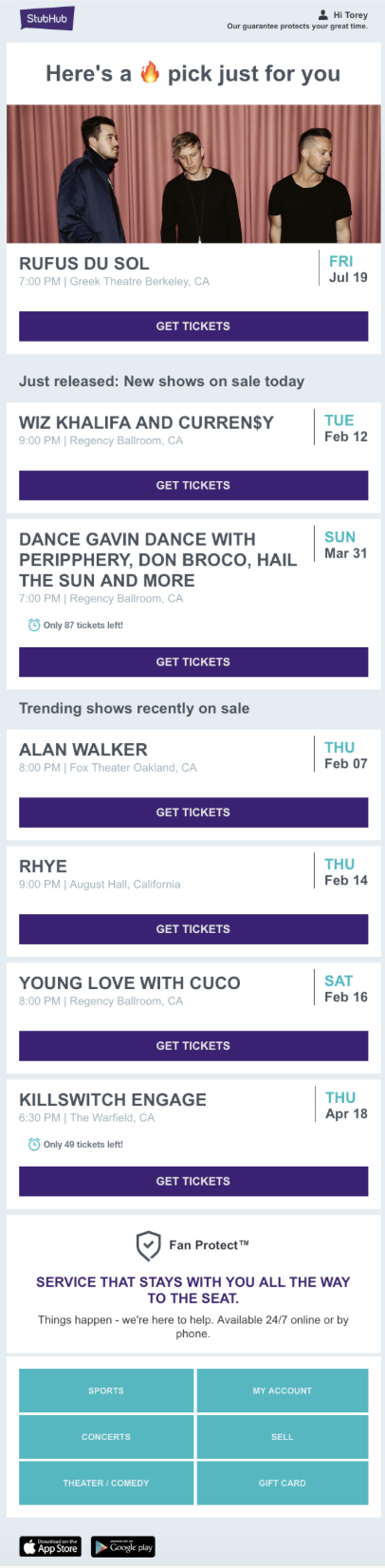
Email Comparison: Earlier Design vs. Redesign
| Design element | Earlier email | Redesigned template |
|---|---|---|
| Hero & featured event | Dense event content with a prominent full-width ticket button. | Featured imagery, clearer event details, and a more focused ticket action. |
| Recommendations | Single-column listings with repeated, uniform buttons. | Flexible event cards with contextual badges and differentiated content. |
| Performer highlights | Primarily text-led event listings. | Image-led performer and event spotlights for easier browsing. |
| Trust & guarantees | Guarantee messaging was less prominent. | More visible FanProtect guarantee and customer-support information. |
| Footer & app access | Category links and standard footer content. | Search, app-download badges, account/help links, and feedback controls grouped together. |
Delivery & Intended Impact
- Cross-functional design: Developed the new email template with the CRM marketing team using StubHub product design standards.
- Prepared for the platform transition: The team scheduled the template for the planned March 18, 2019 SFMC launch, after IP warm-up.
- Testing-ready concepts: Alternative modules were designed for future campaign testing once SFMC was operational.
- Designed for improved usability: The revised hierarchy and responsive presentation prioritize mobile scannability and clearer content structure.
The supplied project materials describe the planned launch and testing approach but do not include post-launch performance or A/B test results.